Causes of high pressure main steam valve stem fracture in a steam turbine
2024,03,24
The main steam valve of the turbine is the first valve before the main steam enters the turbine, and it is the key component to ensure the safe startup and shutdown and operation of the unit, and it has been subjected to complex loads under high temperature and high pressure for a long time. The use of new energy and power grid peaking makes the load on the turbine regulating valve not only concentrated in the start-stop phase, but also generated during the operation of the unit, which increases the risk of fracture of the turbine regulating valve.DL/T 438-2016 “Metal Technical Supervision Regulation for Thermal Power Plants” doesn't involve the metal supervision of the turbine regulating valve, which further increases the risk of fracture of this type of component. The fracture risk of this type of component is further increased, and the fracture of this type of component will lead to the shutdown of the corresponding unit, which will bring about economic losses and the impact on the power grid should not be ignored.
In a cogeneration company, a high-pressure main steam valve stem of a steam turbine fractured during operation. The power of the turbine was 600MW, the inlet pressure was 16.67MPa, the inlet temperature was 538℃, and the reheat temperature was 538℃. When the load was raised, it was found that there was no change in the load when the high-pressure speed control valve was opened, and it was initially judged that the high-pressure main steam valve was in a closed state, and it was found that the door lever was fractured during the shutdown inspection.
The door stem material used for 2Cr12NiMo1W1V martensitic Stainless Steel. 2Cr12NiMo1W1V steel is based on 12% Cr (mass fraction) steel, adjust the carbon, tungsten, nickel and molybdenum content of domestic martensitic stainless steel, commonly used for boilers, turbines, power machinery and other high-temperature parts, in the turbine is mainly used in the door stem, the valve disc. diffuser and other components. 2Cr12NiMo1W1V steel is mainly used for the door stem, the valve disc, 2Cr12NiMo1W1V steel heat treatment process for 1040 ~ 1070 ℃ quenching + 660 ~ 700 ℃ tempering and tempering treatment. Nitriding treatment can make the surface of the material to form a nitride layer with good strength and toughness, to improve the strength, wear resistance, corrosion resistance and anti-seize performance of the surface of the door lever, so the door lever needs to be surface nitriding treatment after molding. Hu Mei from the Inner Mongolia Institute of Mechanical and Electrical Vocational and Technical College of a series of physical and chemical inspection and analysis of the broken door bar, to identify the cause of the breakage of the door bar, and to give a solution to avoid the recurrence of this type of problem.
Part.1
Physical and chemical examination
1.1 Macroscopic observation 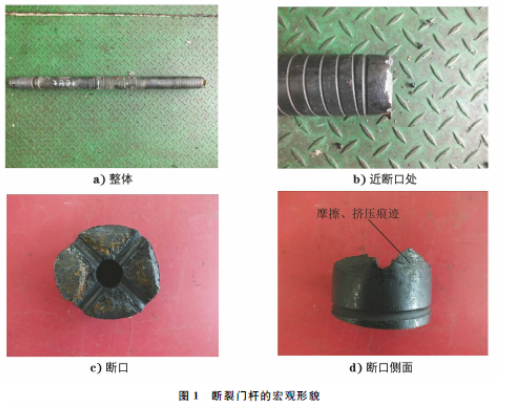
Macroscopic observation of the fractured door lever with a digital camera, the results are shown in Figure 1. As can be seen from Figure 1: the door rod fracture in the air leakage “cross”-shaped through-hole, the fracture has a more obvious necking deformation phenomenon; near the fracture of the surface there are many along the circumferential distribution of small cracks, the fracture originated on the surface of the door rod; fracture of the main expansion area and the door rod axial angle of 45 °, with more typical axial tensile stress overload fracture features The main expansion area of the fracture and the axial intersection angle of the door bar was 45 °, which has a typical axial tensile stress overload fracture characteristics, which can be seen in the “cross”-shaped through-hole with a diameter of 5mm, which is the smallest part of the cross-sectional area of the door bar; the side of the fracture can be seen with the more obvious friction and extrusion traces of the sleeve, and there is a certain thickness of the surface of the door bar oxide skin.
1.2 Chemical composition analysis
Using desktop direct reading spectrometer to analyze the chemical composition of the fractured door rod, according to the experiment, it can be seen that the content of each element in the door rod material are in line with the GB/T 20410-2006 “turbine high temperature bolts with steel” on the requirements of 2Cr12NiMo1W1V steel.
1.3 Metallographic examination 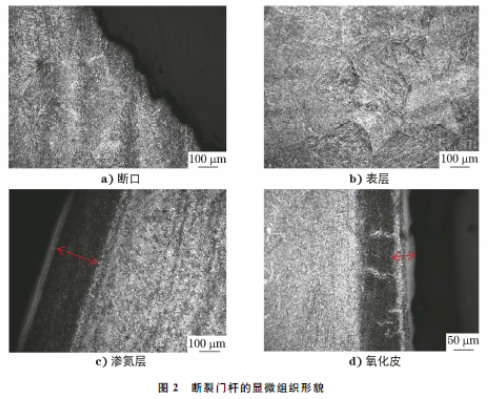
The specimen was intercepted at the fracture of the door bar and metallurgical examination was carried out, and the results are shown in Figure 2. As can be seen in Figure 2: the door rod fracture and matrix parts of the organization are tempered martensite, coarse grain, grain size level of about 0; surface parts of the organization is basically tempered Soxhlet, fine grain, grain size level of 10, the surface and the matrix parts of the grain size of the difference is very large; the surface layer of the nitriding layer can be seen with a thickness of about 150 μm, the nitriding layer can be seen in the many tiny cracks; the surface layer can be seen with a thickness of about The thickness of the nitriding layer is about 150μm, and many tiny cracks can be seen in the nitriding layer.
1.4 Mechanical performance test
Sampling from the fractured door rod, using electronic universal testing machine for tensile test, using digital impact testing machine for impact test, test results shown in Table 1.
Table 1 Mechanical performance test results of fractured door rod
As can be seen from Table 1, the yield strength and tensile strength of the fractured door bar are lower than the minimum requirements of GB/T 20410-2006, and the impact absorption energy is close to the minimum requirements of GB/T 20410-2006.
1.5 Scanning electron microscope (SEM) analysis The fracture of the impact specimen of the door bar was observed by swept SEM, and the results are shown in Fig. 3. As can be seen from Fig. 3, the fracture as a whole presents quasi-dissolutional fracture characteristics, and locally there is a tendency to fracture along the crystal.








