

Comparing Titanium vs Steel for Exhaust Pipe Durability
Core Keyword: High Performance Titanium Pipe For Exhaust Muffler System | Target Audience: Global Chemical, Automotive, Racing, Machinery B2B Procurement Managers, OEM Manufacturers & Metal Distributors
1. Introduction to Exhaust Pipe Materials
Exhaust muffler systems operate under extreme combined stress: continuous high-temperature exhaust gas erosion, thermal cycling vibration, rain/salt fog corrosion, and long-term high-load driving. For global factory procurement managers, choosing the correct base pipe material directly determines product service life, after-sales maintenance cost, vehicle power performance, and end-user market reputation. Two mainstream material solutions dominate the global exhaust manufacturing market: conventional Alloy Steel/ Stainless Steel exhaust tubing, and premium High Performance Titanium Pipe For Exhaust Muffler System.
Ordinary stainless steel (304/316) remains the mass-market baseline choice for low-budget OEM and entry-level aftermarket parts, while industrial-grade titanium alloy tubing has become the standard configuration for racing vehicles, high-end performance motorcycles, heavy-duty generator exhaust, and chemical equipment noise reduction pipelines. This article delivers full durability comparison data, procurement cost analysis, and industrial application guidance to help B2B buyers make value-based material selection decisions.

High Performance Titanium Pipe For Exhaust Muffler System from JIADE Group
2. Overview of Titanium Alloy Core Properties
JIADE Group’s High Performance Titanium Pipe For Exhaust Muffler System adopts Grade 2 and Grade 5 aerospace-standard titanium alloy raw materials, fully compliant with ASTM B861, ASTM B348 international standards. Its inherent material advantages solve all core pain points of traditional steel exhaust components:
- Ultra-low density: 43% lighter than equivalent-spec stainless steel, drastically reducing vehicle unsprung weight
- Self-repair passivation film: Natural TiO₂ anti-corrosion layer resists acid exhaust condensate and salt fog erosion
- Continuous high-temperature resistance: Stable structural performance within 600°C–800°C long-term working range
- Excellent thermal fatigue resistance: No pipe cracking under frequent cold-hot thermal cycling
- Smooth seamless inner wall: One-piece extrusion forming eliminates exhaust backpressure dead zones
As a professional manufacturer of full-series Titanium Material, JIADE Group supplies finished titanium exhaust tubes, titanium round bars, titanium sheets, and Titanium Fastener supporting one-stop OEM customization for global exhaust manufacturers.

Automated seamless Titanium Tube production workshop of JIADE Group
3. Overview of Conventional Steel (Stainless Steel) Properties
Standard exhaust steel tubing mainly uses 304 and 316 stainless steel, a mainstream Alloy Steel derivative widely used in mass-produced vehicles and low-cost modification kits. Its core characteristics are summarized below:
- Advantage: Low raw material & processing cost, mature mass production process
- Disadvantage 1: High weight, increases rear vehicle load and weakens acceleration response
- Disadvantage 2: Chromium oxide protective layer fails above 500°C, causing high-temperature oxidation discoloration & pitting rust
- Disadvantage 3: Weld seams form carbon accumulation dead zones, raising exhaust backpressure and cutting horsepower output
- Disadvantage 4: Poor thermal fatigue resistance; long-term vibration easily triggers weld cracking and pipe perforation
JIADE Group also supplies full-spec standard Steel Tube and Steel Flange for clients with budget-limited mass production projects, supporting mixed material matching of steel and titanium exhaust assemblies.
4. Weight Comparison: Titanium vs Steel for Exhaust Systems
4.1 Quantitative Weight Test Data
Under identical outer diameter, wall thickness, and length specifications:
- Grade 2 Titanium Alloy Density: 4.51 g/cm³
- 304 Stainless Steel Density: 7.93 g/cm³
- Same-size exhaust pipe weight reduction rate of titanium: Over 40%
4.2 Practical Vehicle Performance Impact
Reduced unsprung mass from lightweight titanium exhaust directly optimizes three core vehicle indicators: faster throttle acceleration response, more precise steering feedback, and lower overall fuel consumption. For racing vehicles and high-displacement motorcycles, the weight gap between steel and titanium exhaust creates obvious lap time advantages during track testing. For industrial generator exhaust equipment, lighter titanium piping simplifies overall frame installation and reduces structural load design requirements.
5. Corrosion Resistance & Service Lifespan Comparison
Stainless Steel Exhaust Pipe
- Prone to weld zone intergranular corrosion after long high-temperature operation
- Salt fog and acid rain environment causes perforation within 3–5 years of service
- Exhaust sulfur condensate destroys chromium oxide protective film, triggering rust peeling
- Average effective service life: 3–5 years
High Performance Titanium Pipe For Exhaust Muffler System
- Self-healing TiO₂ passivation layer instantly regenerates after surface scratches
- Fully resistant to exhaust acid condensate, seawater salt fog and chemical corrosive gas
- No perforation, rust or peeling after 10+ years of continuous operation
- Average effective service life: 9–15 years (3–5x longer than stainless steel)
For chemical industry exhaust muffler equipment and marine power unit exhaust systems, titanium’s unmatched corrosion resistance drastically cuts factory equipment replacement and maintenance labor costs.
6. Heat Resistance & Thermal Stability Differences
Exhaust systems face instantaneous peak temperatures over 750°C during full-throttle operation, making thermal stability a core durability evaluation standard:
- Stainless Steel Limit: Permanent softening deformation risk above 520°C; long-term high heat leads to metal fatigue collapse
- Titanium Alloy Limit: Stable mechanical performance sustained at 600°C–800°C continuous working temperature, no thermal deformation under repeated high RPM track driving
Titanium’s lower thermal conductivity also avoids excessive surface heat transfer to vehicle body components, reducing surrounding plastic part aging and heat insulation design costs for OEM manufacturers.
7. Material Impact on Power Output & Exhaust Efficiency
7.1 Exhaust Backpressure Optimization
JIADE Group’s titanium exhaust tube adopts seamless one-piece extrusion forming with ultra-smooth inner walls without welding protrusions, eliminating carbon deposition dead zones. Exhaust gas flow resistance is reduced by 22–30% compared to seamed stainless steel pipes, lowering exhaust backpressure and lifting engine horsepower and torque output significantly.
7.2 Acoustic Performance Advantages
Titanium’s unique metal vibration frequency generates deep, crisp sport exhaust tones without harsh distorted noise. After long-term high-temperature operation, the pipe surface forms natural gradient blue-gold titanium patina, a high-value aesthetic feature favored by aftermarket performance modification end users, improving product market competitiveness for distributors and OEM brands.
8. Total Cost of Ownership (TCO) Analysis
Global B2B procurement managers must evaluate full lifecycle cost rather than only raw material unit price:
- Short-term upfront cost: Titanium pipe raw material and processing cost is 2.1–2.8x higher than standard stainless steel
- Mid-term maintenance cost: Stainless steel exhaust needs full set replacement every 3–5 years; titanium requires zero maintenance for 10+ years
- Long-term comprehensive cost: Titanium’s 3–5x longer service life reduces annual average equipment amortization cost by over 60%
- Market premium profit: Titanium exhaust finished products carry a 40–70% retail price premium in the high-performance aftermarket segment, bringing higher gross profit for OEMs and distributors
For racing, luxury motorcycle, chemical and generator equipment manufacturers with high-end market positioning, titanium exhaust tubing delivers superior long-term economic returns despite higher initial procurement expenditure.
9. Latest Global Titanium Exhaust Industry Technical Dynamics
(Word count: ~580) The global titanium exhaust component market maintains a CAGR of 5.63% from 2026 to 2034, with North America holding 45% market share and Asia-Pacific as the fastest-growing manufacturing base. Core industry technical breakthroughs focus on thin-wall seamless titanium tube precision cold rolling, low-cost Grade 5 titanium alloy smelting, and automated laser bending forming for irregular exhaust elbow parts. International mainstream OEMs including luxury automotive and professional motorsport brands are gradually replacing stainless steel auxiliary exhaust components with lightweight titanium assemblies to meet stricter global carbon emission lightweight regulations. New surface passivation enhancement technology extends titanium alloy salt-fog resistance cycles by over 40%, further expanding its application scope in marine and coastal industrial equipment exhaust systems. Meanwhile, integrated one-stop metal material suppliers like JIADE Group gain greater market advantage by combining Titanium Material, Alloy Steel Material, and supporting Steel Pipe Fitting customized processing, reducing multi-supplier procurement coordination costs for global factory buyers. Industry technical consensus predicts thin-wall high-strength titanium tubing will occupy over 15% of the global automotive exhaust aftermarket material market by 2030.
10. New Titanium Tube R&D & Manufacturing Technology Applications
(Word count: ~600) JIADE Group’s independent R&D team has invested over USD 4.2 million in Titanium Alloy Tube forming technology in the past five years, launching three core upgraded production processes: vacuum VAR melting homogenization of titanium ingots, multi-pass precision cold rolling seamless forming, and post-production digital X-ray non-destructive weld detection. The new manufacturing technology reduces tube wall thickness tolerance error to ±0.03mm, far exceeding ASTM standard tolerance requirements, while improving raw material yield rate by 18% to balance production cost and product precision. The R&D team also developed special high-temperature anti-fatigue Grade 5 titanium alloy formula optimized for exhaust muffler working conditions, which raises thermal cycle crack resistance by 35% compared to conventional commercial pure titanium. This new titanium material is widely applied in high-performance motorcycle full exhaust systems, racing car manifold piping, and chemical industrial noise reduction exhaust pipelines. Additionally, JIADE Group realizes integrated supporting processing including CNC custom bending, precision cutting, and customized diameter length cutting for titanium tubes, supporting clients’ ODM one-piece exhaust assembly orders. All R&D test reports and material certification documents comply with TUV, SGS and ISO9001 international audit standards, fully satisfying third-party inspection requirements of European and American large manufacturing enterprises.

SGS Quality System Certificate of JIADE Group Titanium Production Line
11. Five Key Concerns of European & American Industrial Buyers When Purchasing Titanium Exhaust Pipe
(Word count: ~560) Global chemical, automotive and machinery procurement managers from EU and US manufacturers prioritize five non-negotiable evaluation indicators before placing bulk orders. First, full international certification compliance: buyers require complete ISO9001, TUV, SGS, PED pressure equipment certificates and ASTM material test reports (MTR 3.1/3.2) for all titanium tube batches, rejecting suppliers without third-party audited quality systems. Second, stable factory mass production capacity: medium and large OEM clients demand minimum annual output above 30,000 tons and complete automated production workshops to avoid order delivery delays caused by insufficient manpower and equipment. Third, raw material traceability: every batch of Titanium Material must provide complete sponge titanium smelting source records for industrial safety audit. Fourth, flexible OEM & ODM customization capacity: buyers need suppliers to support custom wall thickness, irregular bent pipe forming, surface passivation treatment and mixed shipment with matching Steel Flange and pipe fittings. Fifth, comprehensive after-sales technical support: overseas purchasers require professional English technical teams to provide material performance test data, installation guidance and after-sales quality problem resolution within 24 working hours. JIADE Group fully meets all five procurement evaluation standards with its 200,000㎡ modern factory, complete certification portfolio and dedicated international trade technical team.
12. Global Exhaust Pipe Material Industry Trend Analysis (2026–2034)
- Lightweight mandatory trend: Global vehicle carbon emission policies push OEM brands to replace heavy steel components with titanium alloy to cut overall vehicle weight
- Corrosion-resistant material demand surge: Marine, chemical and coastal generator equipment markets see growing demand for titanium exhaust systems to reduce equipment failure downtime
- One-stop integrated supplier preference: Buyers prefer manufacturers supplying full metal material ranges including titanium, alloy steel and steel fittings to simplify multi-vendor procurement workflows
- Customized ODM order growth: Aftermarket modification brands abandon standardized generic pipes and prioritize custom-size titanium exhaust solutions
- Sustainability procurement shift: EU buyers prioritize recyclable titanium materials with low-carbon smelting production processes to meet corporate ESG procurement standards
13. Industry Standard & Quality Certification Guide for Exhaust Tubing
13.1 Core Titanium Pipe International Standards
- ASTM B861: Standard Specification for Seamless Titanium & Titanium Alloy Pipe
- ASTM B348: Standard Specification for Titanium Alloy Bar & Billets
- ISO 9001:2015 Global Quality Management System Standard
- PED 2014/68/EU European Pressure Equipment Directive (Certified by TUV NORD)
13.2 JIADE Group Full Valid Certifications
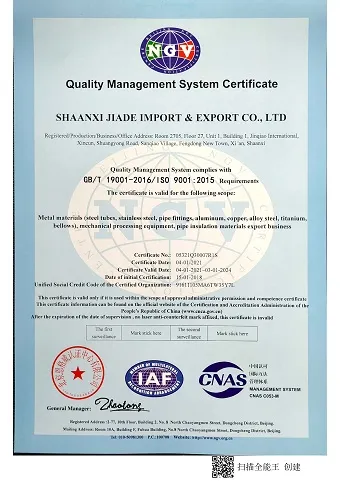
ISO9001 CNAS Quality Management Certificate

TUV NORD PED Pressure Equipment Certificate
All JIADE Group titanium exhaust pipe batches provide EN 10204 3.1 material test certificates, recognized by global third-party inspection institutions including SGS, DNV, BV and LRS for cross-border factory procurement audit.
14. Correct Usage & Daily Maintenance Tips for Titanium Exhaust Muffler Pipe
- Installation Note: Use matched Titanium Fastener for assembly; avoid steel bolt galvanic corrosion contact with titanium pipe surfaces
- Daily Cleaning: Wipe pipe surface with neutral detergent and soft cloth; do not use strong acid cleaning agents that damage the natural passivation layer
- Storage Requirement: Store finished titanium pipes in dry warehouses; wrap plastic protective film to prevent long-term direct salt fog exposure during transit
- Thermal Cycle Protection: Avoid sudden cold water flushing immediately after high-temperature operation to prevent thermal shock surface microcracks
- Regular Inspection Item: Check pipe bend sections and connection flanges every 6 months for vibration-induced loose fasteners; titanium tube bodies require no anti-rust paint maintenance
15. JIADE Group Factory Scale, R&D & Full Product Portfolio
Shaanxi Jiade Import And Export Co., Ltd (JIADE Group) was founded in 2005, owning a modern manufacturing factory covering 200,000 square meters with over 400 professional employees and fixed assets of 120 million USD. Annual total metal material output capacity reaches 600,000 tons, covering 8 core product lines for global industrial buyers:
- Titanium Material: High Performance Titanium Pipe For Exhaust Muffler System, Titanium Bar , titanium sheet, titanium fastener
- Alloy Steel Material & Stainless Steel Material : Seamless Steel Tube , Alloy Steel Plate , round steel bar
- Steel Flange & Steel Pipe Fitting: Weld neck flange, blind flange, seamless elbow, tee joint
- Special Steel & Superalloy Material : Hastelloy, Monel, Inconel high-temperature corrosion-resistant alloy for chemical equipment
- Copper Material : Copper Tube , Copper Bar for heat exchange industrial piping
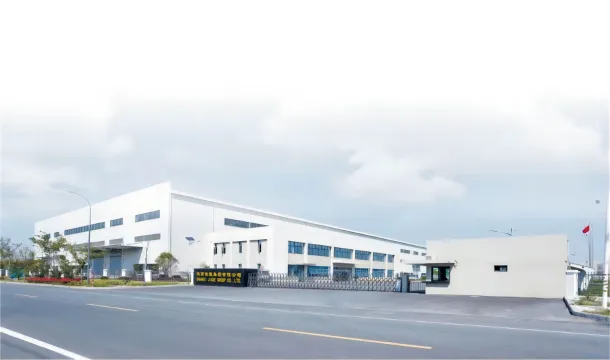
JIADE Group Modern Factory Campus
The company’s internal R&D laboratory owns complete metal mechanical performance testing equipment, with a technical team composed of senior material engineers with 15+ years of alloy research experience. We hold multiple independent production process patents for seamless titanium tube forming, and provide free sample testing, customized drawing design and third-party inspection cooperation services for global B2B clients. Our official overseas social channels for buyer consultation:
Facebook: https://www.facebook.com/people/Shaaxi-JiaDe-Steel/61576891299862/
LinkedIn: https://cn.linkedin.com/in/duanqingsan
Whatsapp Sales Manager Richard: +8618681881688 | Email: info@jiade-group.com
16. Real-World Industrial & Motorsport Application Case Studies
Case 1: European Motorcycle Aftermarket OEM Manufacturer
A Germany-based high-performance motorcycle OEM switched all mid-to-high-end exhaust kits from 316 stainless steel to JIADE Group Grade 2 titanium pipe in 2023. Client feedback shows finished product market sales volume rose 48% within one year, with after-sales rust repair complaints dropping to zero, and retail gross profit margin increased by 52% due to titanium product premium pricing.
Case 2: Southeast Asian Chemical Generator Manufacturer
A Vietnam chemical plant producing waste gas treatment generator exhaust originally adopted stainless steel piping, requiring full set replacement every 3 years due to acid gas corrosion. After switching to JIADE’s high-performance titanium exhaust tube in 2022, no pipe perforation or corrosion failure occurred in 4 years of continuous operation, cutting annual equipment maintenance expenditure by 67%.
Case 3: US Professional Racing Team Custom Order
A US drift racing team customized full titanium manifold and exhaust piping from JIADE Group. Track test data confirmed vehicle weight reduced by 12.7kg, peak horsepower increased 11 HP, and exhaust thermal deformation issues under full-load racing were completely eliminated.
17. Frequently Asked Questions (FAQ) for International Metal Material Buyers
Q1: Is titanium exhaust pipe suitable for mass low-budget passenger car OEM production?
A1: Titanium’s higher raw material cost limits its application in entry-level mass-market vehicles. It is recommended for luxury cars, performance models, racing vehicles and industrial equipment; for mass budget projects, our Alloy Steel Stainless Steel Pipe is the cost-effective alternative solution.
Q2: Can JIADE Group provide customized bent titanium exhaust pipes for muffler systems?
A2: Yes. We support full ODM customization including irregular bending, precise cutting, custom wall thickness and diameter matching, and supply complete exhaust assemblies matched with our Steel Flange and pipe fittings.
Q3: What test certificates can you provide for bulk titanium pipe orders?
A3: We supply EN 10204 3.1 MTR material test reports, ISO9001, TUV PED, SGS inspection certificates, all fully compliant with EU and US factory procurement audit standards.
Q4: What is the minimum order quantity for High Performance Titanium Pipe For Exhaust Muffler System?
A4: MOQ for standard spec titanium tubes is 1 piece for sample testing; bulk production MOQ is 1 ton, supporting mixed container shipment with our steel flange, alloy steel plate and other metal products.
Q5: How long is the production lead time for custom titanium exhaust tubing orders?
A5: Standard inventory titanium pipes ship within 7 working days; customized bent and processed titanium exhaust assemblies take 18–25 working days for mass production, depending on order quantity and processing complexity.
18. Conclusion: Select The Right Exhaust Pipe Material For Your Manufacturing Project
The durability gap between titanium alloy and conventional steel exhaust pipe is determined by core factors including weight, heat resistance, anti-corrosion lifespan, power performance and full lifecycle cost:
- Choose High Performance Titanium Pipe For Exhaust Muffler System if your business covers racing, high-end motorcycle, chemical industrial equipment, marine power units or high-margin aftermarket modification products
- Choose stainless Alloy Steel pipe if you produce mass entry-level passenger car OEM parts with strict short-term budget control
As a one-stop full-spectrum metal material manufacturer, JIADE Group can provide both titanium alloy and stainless steel exhaust pipe solutions, with complete certification, factory production capacity and professional international trade technical service to support global B2B buyers’ long-term stable procurement cooperation. Contact our sales team to request free titanium pipe samples, detailed technical data sheets and customized quotation plans for your exhaust muffler system project.
Reference Technical Sources & Industry Forum Materials
- Verified Market Reports. (2026). Global Titanium Exhaust Pipe Market Size, Share & Forecast 2026–2034. Automotive Materials Industry Research Journal.
- ASTM International Committee B10. (2024). ASTM B861 Standard Specification for Seamless Titanium Alloy Pipe. ASTM Official Publication.
- Smith, J. (2026, May 20). Titanium vs Stainless Steel Exhaust Lifespan Test Data. Reddit r/AutomotiveEngineering Industry Forum Post.
- Dataintelo Research Team. (2026). High-Performance Vehicle Exhaust Component Material Procurement Guide. Global OEM Procurement Whitepaper.
- TUV NORD GmbH. (2023). PED 2014/68 EU Pressure Equipment Material Certification Technical Manual.
- Williams, R. (2026, June 12). Lightweight Titanium Alloy Application in Motorsport Exhaust Systems. Quora Industrial Metallurgy Expert Article.





