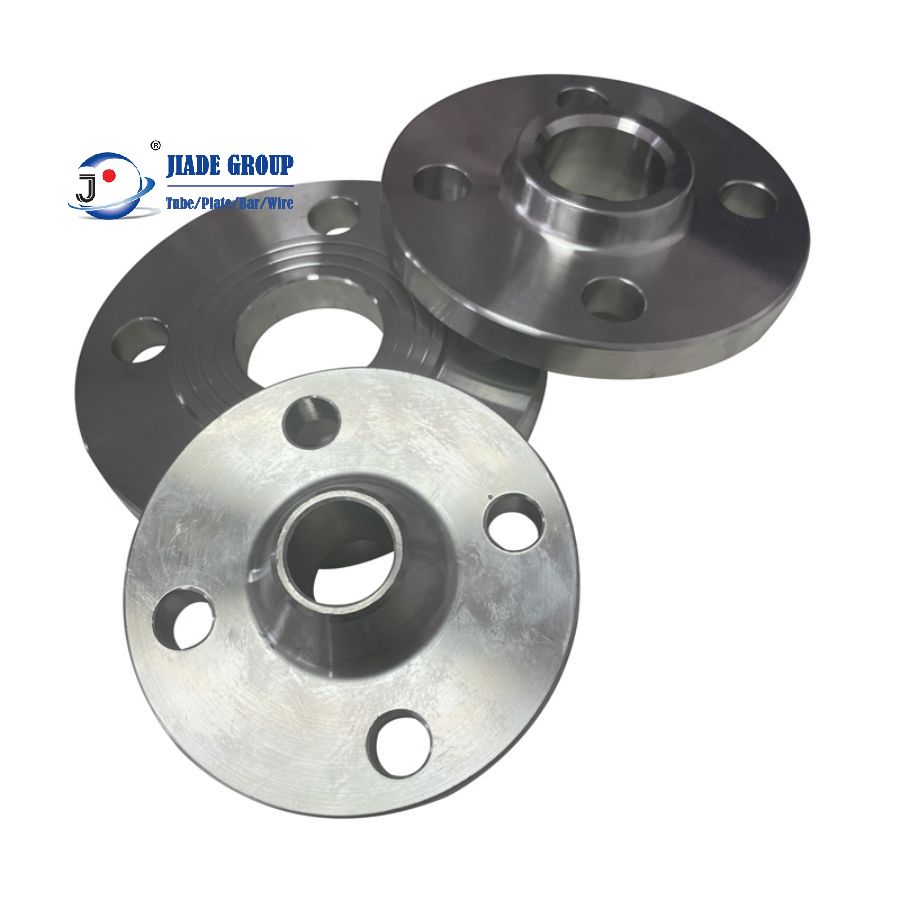
Welding flanges are pipe to pipe interconnecting parts that are attached to the end of the pipe. It is also widely used in Steel Flange. Welding flanges have eyelets and bolts to keep the two flanges tightly connected. Between the gasket sealing. Welding flange is a disk-shaped parts, the most common in the pipeline project welding flange connection is the two pipes, fittings or equipment, first each fixed on a welding. Between the two welding, plus flange gasket, bolted together, completed the connection. Welding is an important connection for high-pressure pipeline construction. Welded flange connection is easy to use and can withstand high pressure. Welding Alloy Steel Flange is widely used in petroleum, chemical, natural gas, power station, metallurgical pipeline and other fields. Welding flange standard system
There are two main systems of international pipe flange standards, i.e. the European pipe flange system represented by German DIN (including the former Soviet Union) and the American pipe flange system represented by American ANSI pipe flange. In addition, there is the Japanese JIS pipe flange, but in the petrochemical plant is generally used only for public works, and in the international influence is small. Now the countries pipe flange profile below:
(1) Germany and the former Soviet Union as the representative of the European system pipe flange
(2) American system pipe flange standard, ANSI B16.5 and ANSI B 16.47 on behalf of the
(3) British and French pipe flange standards, the two countries have two sets of pipe flange standards.
In summary, the international pipe flange standard can be summarized as two different, and can not be interchangeable pipe flange system: a Germany as the representative of the European pipe flange system; the other is the United States as the representative of the American pipe flange system.
Required equipment and tools
A set of manual welding equipment, a handle angle grinder, an electric air hammer, a plane ruler. Welding preparation
1. Check and debug the equipment to ensure normal operation;
2. Prepare φ4.0J506 welding rod preferably dried at 300℃-350℃ for one hour.
Welding process
1, assembly of the vertebrae and large flange according to the drawings required to be assembled together, and then evenly divided into 8 equal parts of the large flange.
2、Welding due to the flange is thicker, the bevel is larger, so the use of symmetrical segments, multi-layer welding.
Weld quality
The strength of the weld is required to reach at least the strength of the base material. The surface of the weld is flat and smooth, without burn-through, porosity, weld leakage, slag, biting edge, not fully welded and other defects. The residual height is less than 2mm.
Precautions
1, bottoming must use J506 electrode manual surfacing welding, and use small current welding. Strictly in accordance with the welding process.
2, and then every position after welding, should use a level ruler to card the amount of deformation of the flange plane.
3、Welding while using a gas hammer to hammer the weld to achieve the role of stress relief.


 Contact Now